
 02-Sep-2026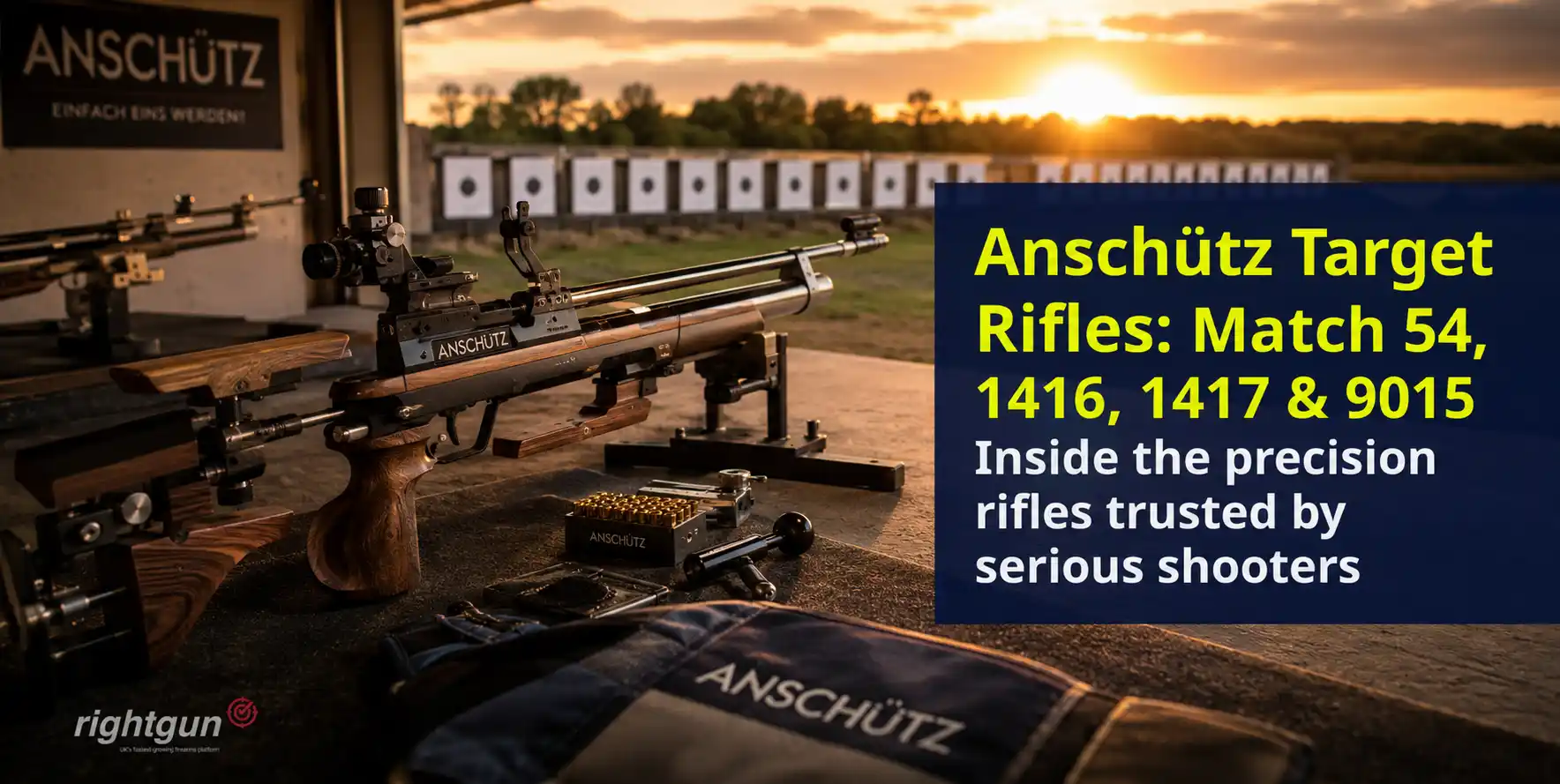
Few names carry the same weight in precision shooting as Anschütz. The German maker has supplied Olympic and world-championship winning rifles for decades, and for British shooters the marque spans an unusually wide territory, from a lightweight sporter used for rabbits on a summer evening to a full-house match rifle on an indoor range.
That breadth causes confusion. The model numbers are similar, the actions overlap, and the same barrelled action appears under different designations depending on how it has been stocked. This guide sets out what the main Anschütz families actually are, who each one suits, and what to watch for when buying used in the UK.
The Match 54 action: The foundation
Almost every conversation about Anschütz eventually arrives at the Match 54 action. Introduced in the 1950s and refined ever since, it is the rimfire target action against which others are measured, and it underpins the company’s competition rimfire rifles.
What sets it apart is consistency. The action is built to tight tolerances with a lock-up and bedding arrangement designed for repeatable barrel harmonics, and it pairs with Anschütz’s own two-stage match triggers, which are adjustable to very light and very crisp settings within the bounds of safe use.
You will encounter the Match 54 in several guises: in full match dress with a heavy barrel and adjustable target stock for prone and three-position shooting, and in lighter sporting configurations. Rifles built around this action are the ones that hold their value most stubbornly on the used market, and for good reason.
Browse: Anschütz rifles for sale
The 1400 series: 1416 and 1417
The 1416 and 1417 are the sporting rimfires most British shooters meet first. Built around the smaller 64-series action rather than the Match 54, they are lighter, handier rifles aimed at hunting and general shooting rather than formal competition.
The 1416 is the classic sporter, a bolt-action .22 LR with a sporting-weight barrel, well regarded for accuracy that comfortably exceeds what most quarry shooting requires. The 1417 covers similar ground with variations in stock and barrel specification.
For vermin control, rabbiting and informal target work, this is the sensible end of the Anschütz range. You get the trigger quality and build standard the marque is known for without the weight or the cost of a match rifle.
Browse: Anschütz 1417
The 1700 series: 1710, 1727 and 1761
The 1700 family sits between the sporters and the match rifles, and this is where the Match 54 action reappears in sporting form. The 1710 in particular is prized as a hunting and precision-sporting rifle built on the match action, giving target-grade consistency in a package you can carry.
The 1727 brings a straight-pull action to the same broad concept, a configuration that has found favour with shooters who want faster follow-up shots without leaving the bolt-action world. The 1761 is a more recent design with a shorter, lighter action.
If you want one rifle that will shoot small groups on paper and still earn its keep in the field, this is the family to look at.
Browse: Anschütz 1710 · Anschütz 1727 · Anschütz 1761
The 9015: Match air rifle
The 9015 is a different animal entirely, a 10-metre match air rifle built for Olympic-discipline air rifle shooting. It is pre-charged, single-shot, and configured with the extensive adjustability that formal air rifle competition demands: adjustable cheekpiece, butt plate, hand stop and grip, plus a match trigger and diopter sights.
It is not a hunting rifle and is not intended to be. If you shoot ten-metre air rifle at club or national level, or you are aiming to, this is the relevant model. It appears reasonably often on the UK used market as competitors trade up or move on from the discipline.
Browse: Anschütz 9015 air rifles
Which one should you buy?
Ten-metre air rifle competition → the 9015.
Prone, benchrest or three-position rimfire competition → a Match 54-actioned match rifle.
One rifle for accurate field work and paper → the 1710 or another 1700-series rifle.
Rabbits, vermin and general .22 shooting → the 1416 or 1417.
Faster cycling in the field → the straight-pull 1727.
Buying an Anschütz used: What to check
These rifles last, but they are not immune to neglect.
Bore condition. Rimfire barrels are shot out far less often than people assume, but a badly cleaned bore, particularly one damaged at the crown by careless rod work, will cost you accuracy.
Trigger settings. Match triggers are highly adjustable and previous owners adjust them. Have any second-hand rifle checked by a competent gunsmith to confirm it is set within safe limits.
Stock fit and hardware. Match stocks carry a lot of adjustable furniture. Missing hand stops, butt plates or cheekpiece hardware are expensive to replace and drag down resale.
Sights. Diopter sights and their inserts are a meaningful part of a match rifle’s value. Confirm what is included.
Original specification. Match rifles are frequently modified. Original parts, cases and documentation matter to the next buyer as much as to you.
Frequently asked questions
What is the Anschütz Match 54? It is Anschütz’s long-running rimfire target action, used as the basis for the company’s competition rifles and for higher-specification sporting rifles such as the 1710. The name refers to the action, so it appears across several complete rifle models.
What is the difference between the 1416 and the 1710? Broadly, the action. The 1416 uses the lighter 64-series sporting action, while the 1710 is built on the Match 54 target action. The 1710 is heavier and costs more, and generally delivers greater consistency.
Is the Anschütz 9015 suitable for hunting? No. It is a single-shot ten-metre match air rifle designed for formal target competition, with target sights and no provision for field use.
Do Anschütz rifles hold their value? Historically, yes, particularly Match 54-actioned rifles and complete match outfits in original specification with their sights and accessories. Condition and completeness drive the price more than age.
Browse Anschütz listings
See what is currently available across the range in the Anschütz rifles and Anschütz air rifles sections on Rightgun.uk. Selling an Anschütz? A dedicated UK shooting marketplace puts it in front of the target and field shooters actively looking for one.
Further reading: Anschütz 1416 and 1782 review, Anschütz 9015 match air rifle, Rimfire vs centrefire explained and CZ 455 vs CZ 457.
