
 11-Aug-2026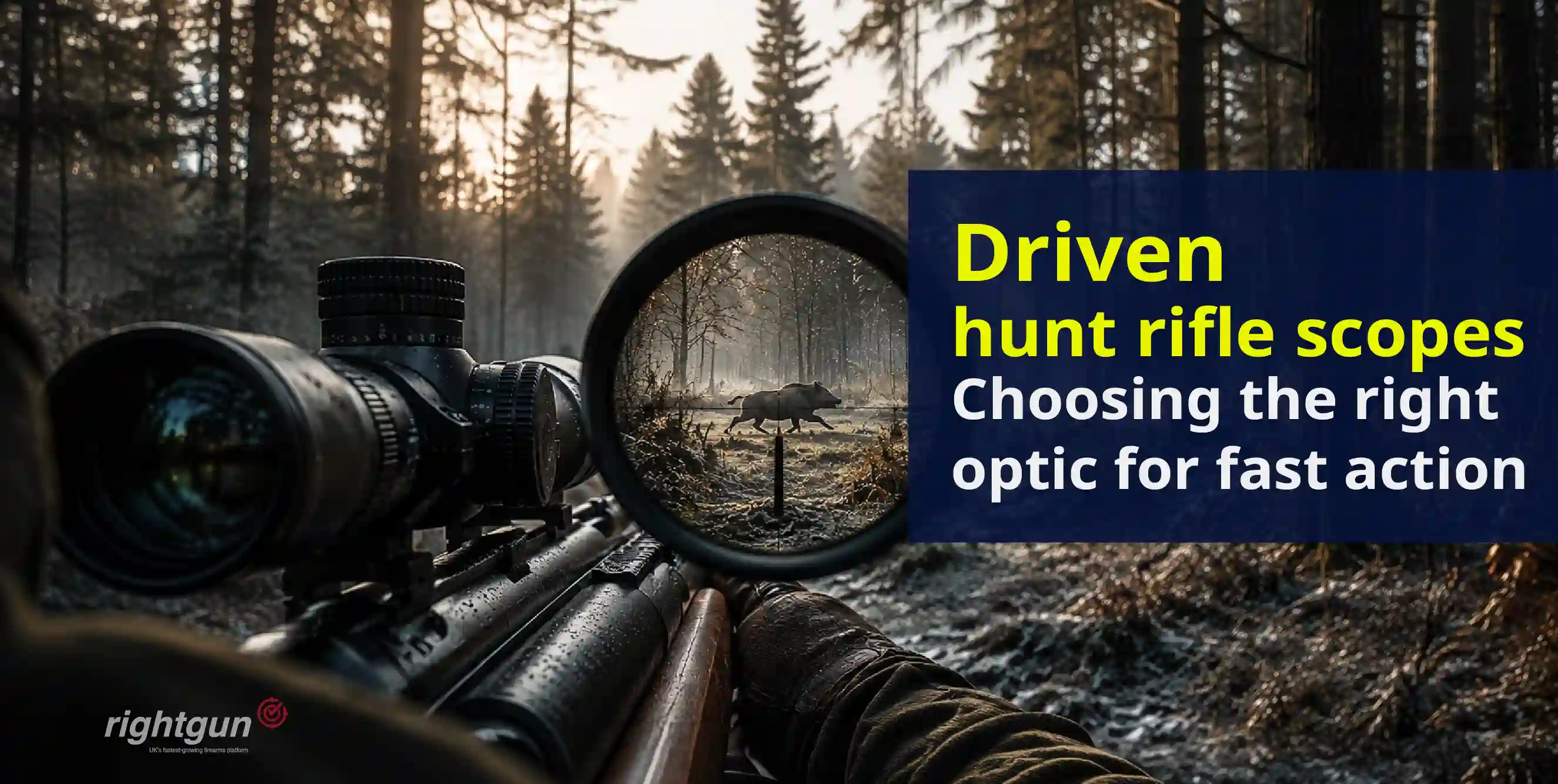
Driven hunting asks something very different of a rifle scope than a dawn stalk on a Highland hill. Game appears suddenly, moves quickly, and is usually inside a hundred metres, often inside thirty. The optic that excels at picking a roe buck off a distant field edge is precisely the wrong tool for the peg. With more UK shooters travelling to driven boar and game hunts in Europe, and driven-style days growing here at home, search interest in driven hunt rifle scopes is rising. Here’s how to choose well.
What driven shooting demands from an optic
Three things dominate: field of view, speed of target acquisition, and both-eyes-open shooting. At close range on moving game, a wide field of view keeps the animal in the picture as it runs, low magnification stops the image swimming, and a bright, bold aiming point lets your eye stay on the target rather than hunting for a fine crosshair.
Generous eye relief and a forgiving eyebox matter too; you’ll be mounting the rifle quickly, sometimes at awkward angles, and a scope that demands a perfect cheek weld will cost you shots. Ruggedness rounds out the list: driven days involve weather, knocks, and rapid handling.
Low-power variables: the driven standard
The classic driven hunt optic is a low-power variable, typically something in the 1–6x or 1–8x class. Set at 1x or thereabouts, it behaves almost like a red dot with both eyes open; wound up, it handles a follow-up shot across a clearing or duties on a stalking day later in the trip. This flexibility is why the format dominates driven hunting across Europe.
Look for a true (or near-true) 1x at the bottom end, a bright illuminated centre dot with intensity settings that hold up in daylight, and a wide field of view at minimum magnification. A second-focal-plane illuminated dot that stays the same visual size regardless of magnification suits most driven work well.
Red dots and combination setups
For pure driven use at short range, a quality reflex red dot is hard to beat: unlimited eye relief, no eyebox to manage, and the fastest possible acquisition. The trade-off is versatility; a dot alone limits you when a longer, deliberate shot presents itself.
Premium European makers also offer dedicated driven-hunt solutions, from wide-angle scopes to clever sighting systems, our review of the Swarovski dS Gen II shows how far top-end optics have come, though that particular model is a precision optic rather than a driven specialist. Whatever you choose, quality glass from established brands like Schmidt & Bender, browse the Schmidt & Bender optics listings, earns its keep in the fading light of a winter drive.
Mounting, zeroing and practice
A driven setup lives or dies on its mounting. Fit the scope as low as the objective allows while keeping a natural head position on a quick-mount, and consider quick-detach mounts if you’ll swap between a driven optic and a stalking scope on the same rifle, a common approach on switch-barrel rifles like the Blaser R8, which was designed with exactly this kind of versatility in mind.
Zero at a sensible driven distance and confirm your point of impact at the ranges you actually expect. Then practise the mount: dry mounting at home and moving-target practice at a range that offers a running boar target will do more for your driven shooting than any amount of optic spending. Remember that UK quarry and European driven game differ, so make sure your rifle, calibre, and optic combination satisfies the requirements of the country and ground you’re hunting.
Reticles and focal planes for fast shooting
Reticle choice on a driven optic is about boldness, not precision. A simple illuminated dot, or a bold German-style post-and-dot pattern, draws the eye instantly; fine target crosshairs and cluttered ballistic trees do the opposite. At driven distances, there’s no holdover to calculate, so every extra line in the reticle is visual noise.
Focal plane matters more than many buyers realise. A second-focal-plane reticle keeps the dot the same apparent size at every magnification, ideal when you’re shooting at 1x and want the boldest possible aiming point. First-focal-plane designs, prized in precision shooting, shrink the reticle at low power exactly when you need it most visible. For driven work, second focal plane with strong daylight illumination is the sensible default, which is precisely the configuration the European driven-hunt scopes are built around.
Low light: the drive doesn’t wait for the sun
Driven days run in winter, drives push through dark timber, and the last drive of the day often finishes in genuinely poor light. This is where optical quality separates itself: light transmission, coating quality, and a generous exit pupil determine whether you can identify and shoot cleanly at the day’s end.
A 24mm objective at 1x gives an exit pupil far larger than your eye can use, so driven scopes are less handicapped in low light than their small objectives suggest. Where premium glass earns its money is contrast and colour fidelity against dark backgrounds; picking a boar out of shadow is a resolution problem, not a brightness one. If you shoot driven game regularly, spend up on glass before anything else in your kit.
Budgeting: where the money goes
With driven optics, you’re paying for glass quality, daylight-visible illumination, and mechanical durability under recoil and rough handling. Mid-market low-power variables now offer remarkable performance, while the premium European houses add brighter illumination, wider fields of view, and better low-light transmission. Buying quality used optics is a sensible route; glass doesn’t wear out the way actions do, and our broader thoughts in the rising cost of shooting apply doubly to optics: buy once, cry once.
FAQs
What magnification do I need for a driven hunt? Low, most driven shots are taken at 1–4x. A 1–6x or 1–8x variable covers driven work at the bottom end with enough top end for other duties.
Is a red dot better than a scope for driven boar? At short range, a red dot is faster, but a good low-power variable at 1x gives up very little speed and adds flexibility for longer shots. Many experienced, driven shooters now favour the variable.
Does illumination matter on a driven scope? Yes, a daylight-bright illuminated dot draws the eye instantly onto moving game, especially against dark woodland backgrounds. Check the illumination is genuinely visible in daylight, not just at dusk.
Can I use my stalking scope for a driven day? A high-magnification stalking scope makes close, fast shots genuinely difficult. If one rifle must do both jobs, quick-detach mounts with a dedicated driven optic are the proven answer.
Find your driven hunt setup on Rightgun.uk
The right optic transforms a driven day. Browse quality sights and scopes for sale, explore rifles suited to driven work, and compare listings from trusted UK sellers on Rightgun.uk, the dedicated marketplace for the British shooting community.
Read next:
