
 07-Sep-2026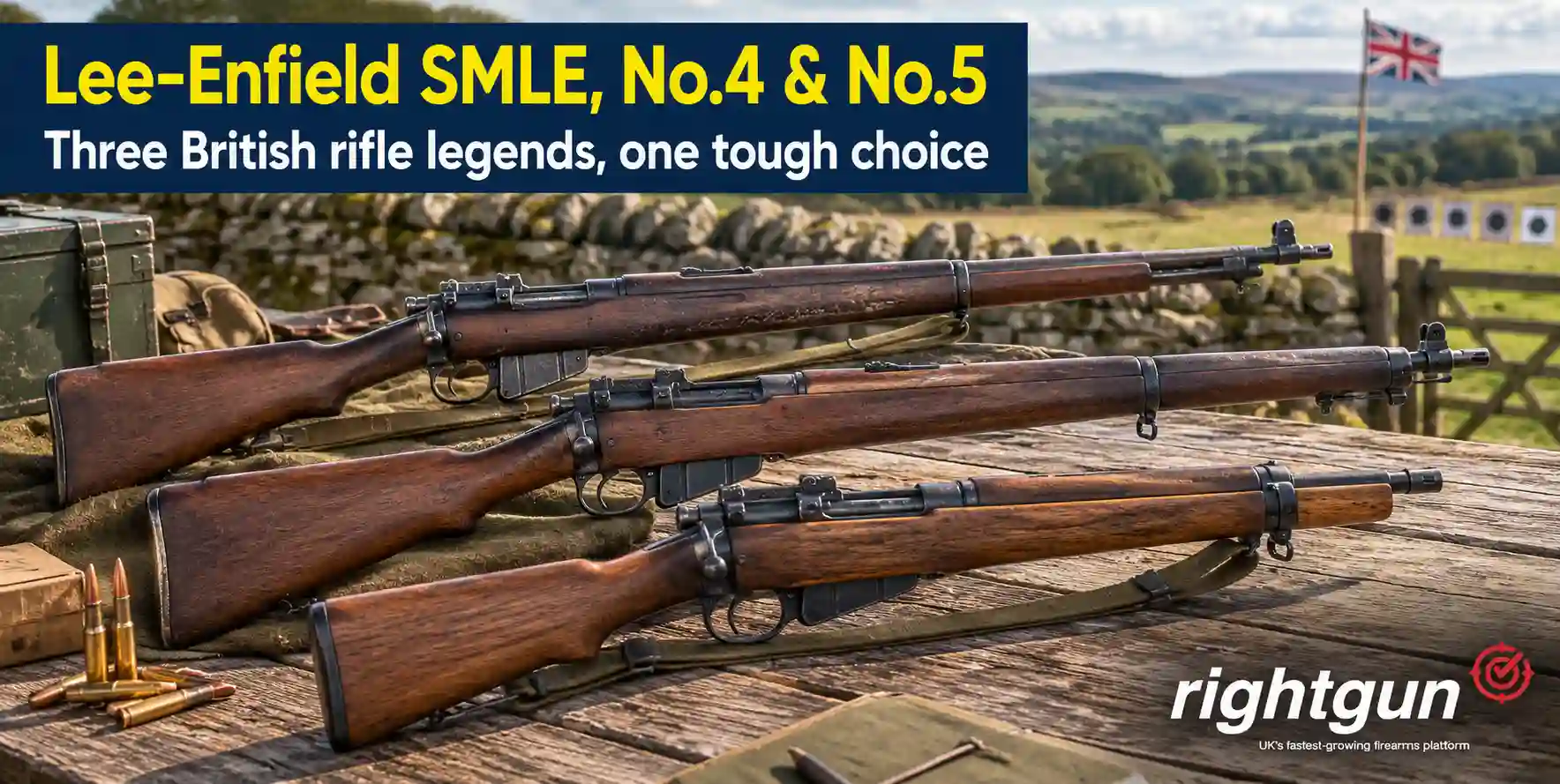
Interest in the Lee-Enfield has climbed sharply this year, and it is easy to see why. A rifle that armed the British Empire through two world wars, that still shoots well over a century after the first examples left Enfield, and that can be bought for less than a mid-range modern sporter is a rare combination. But “Lee-Enfield” is not one rifle; it is a family, and the three you will actually encounter on the UK market handle, shoot and hold their value in quite different ways.
This guide compares the SMLE, the No.4 and the No.5 “Jungle Carbine” on the things that matter when you are choosing one: how they shoot, what condition to expect, and what you should be paying.
The three rifles in brief
The SMLE, Short Magazine Lee-Enfield, formally the Rifle No.1, is the First World War rifle and the one most people picture. Full-length wooden furniture running almost to the muzzle, a distinctive snub nose cap, and barrel-mounted open sights. Production ran from the early 1900s through to the Second World War, with the Mk III and Mk III* being by far the most common variants in circulation.
The No.4 replaced it from 1941. It is the Second World War rifle: heavier barrel, exposed muzzle, receiver-mounted aperture sights and a simplified, faster-to-manufacture design. Millions were built in Britain, Canada and the United States, which is precisely why it remains the most available and generally the best-value Lee-Enfield today.
The No.5 Mk I, universally called the Jungle Carbine, is the shortened, lightened derivative introduced late in the war for jungle and airborne use. Cut-down barrel, flash hider, rubber butt pad, and lightening cuts through the receiver and barrel. Far fewer were made, and that scarcity shows in the price.
Browse: Lee-Enfield rifles · SMLE · No.4 · No.5 · No.1
Sights and accuracy: why the No.4 usually wins
The single biggest practical difference between the SMLE and the No.4 is the sighting arrangement. The SMLE uses barrel-mounted open sights with a fairly short sight radius by comparison, and while they are perfectly usable, they demand good eyes and good light. The No.4’s receiver-mounted aperture sight sits much closer to the eye, gives a longer sight radius, and is markedly easier to shoot precisely with, particularly for anyone over forty.
Add the No.4’s heavier barrel profile and the accuracy gap widens further. A sound No.4 with a decent bore will hold respectable groups at 100 yards with suitable ammunition, and better again if you find one of the target-configured variants.
None of this makes the SMLE a poor rifle. It is a superb piece of engineering with genuinely fast bolt manipulation, and for collectors the First World War association is the point. But if you intend to shoot the rifle regularly at paper or on a range, the No.4 is the easier gun to shoot well.
Browse: No.4 rifles · Lee-Enfield · Rifles for sale · Rifle scopes and optics · Parker-Hale
The No.5 Jungle Carbine: charisma at a cost
The No.5 is the one everybody wants, and comparatively few should buy first. It is genuinely lovely to carry, noticeably shorter and lighter than either full-length rifle, and the handiest bolt-action .303 ever issued. It also recoils considerably harder because of that reduced weight, despite the rubber pad, and the flash hider makes the muzzle blast conspicuous.
The rifle also carries the reputation of the “wandering zero”, a long-argued question of whether the lightening cuts allowed the receiver to flex. Whatever the underlying truth, it has been repeated for eighty years, and it does affect how the rifles are perceived.
Scarcity is the bigger practical issue. Genuine No.5s command a substantial premium over No.4s, and the market contains conversions, No.4 rifles cut down to resemble carbines. Check for the correct receiver lightening cuts, the No.5-specific butt and the proper fore-end, and be sceptical of anything priced suspiciously close to a standard No.4.
Browse: No.5 Jungle Carbine · Lee-Enfield rifles · SMLE · Rifles for sale · UK gun dealers
Condition matters more than variant
Whichever model you settle on, condition will drive both your shooting experience and your resale far more than the model designation. Three things to look at closely.
The bore. A century of corrosive priming has been unkind to many of these rifles. A bright bore with sharp rifling is worth paying a real premium for; a dark, pitted bore may still shoot acceptably but will never be a target rifle.
Matching numbers. Bolt, receiver and often fore-end were numbered together. Wartime rebuilds and post-war refurbishment programmes mixed a great many of these up, so mismatched rifles are common and not a fault as such, but matching examples carry a clear premium among collectors.
Wood and headspace. Original furniture in good order is increasingly scarce, and replaced or heavily sanded stocks knock value. Headspace on a rifle of this age should be checked by a gunsmith before serious use, particularly on rifles that have been through multiple rebuilds.
Browse: Lee-Enfield rifles · Mauser · BSA rifles · Gun parts and accessories · Safes and cabinets
Which one is right for you?
If you want a shooting rifle and the best value, buy a No.4 with a good bore. It is the most available, the easiest to shoot accurately, the cheapest to feed into, and the one with the widest parts and spares support.
If the First World War is the draw, or you simply prefer the classic full-length profile, buy an SMLE Mk III and accept that the sights ask more of you.
If you want the No.5, buy it because you want a Jungle Carbine specifically, not as a general-purpose .303. Verify authenticity carefully and expect to pay for the privilege.
Across all three, spend the extra on condition rather than on rarity. A well-kept common rifle beats a tired scarce one on almost every measure that matters day to day.
Browse: Lee-Enfield rifles · No.4 · SMLE · No.5 · Rifles for sale
Frequently asked questions
Can you own a Lee-Enfield rifle in the UK? Yes. A .303 bolt-action rifle is a Section 1 firearm and is held on a firearm certificate, granted by your local police force, with the calibre and a good reason recorded on the ticket. Target shooting through a Home Office approved club and, where appropriate, deer stalking are commonly accepted good reasons.
What is the difference between an SMLE and a No.1 Mk III? They are the same rifle. “SMLE” is the descriptive name; “Rifle No.1 Mk III” is the formal designation adopted in the 1920s nomenclature revision. Listings use both, sometimes interchangeably.
Is a Lee-Enfield accurate enough for target shooting? A sound No.4 with a good bore is competitive in classic and service rifle disciplines, which is exactly where most of them are shot today. Match-grade precision it is not, but it is far more capable than its age suggests.
How much should I pay for a Lee-Enfield in the UK? Prices vary widely with condition, originality and variant, with No.4 rifles the most affordable, SMLEs somewhat above them and genuine No.5 carbines commanding a significant premium. Compare current listings rather than working from old price guides, as this part of the market has moved considerably.
Browse Lee-Enfield rifles on Rightgun.uk
Whether you are after a shooting No.4, a collector’s SMLE or a genuine Jungle Carbine, the Lee-Enfield market rewards a careful eye. Explore current Lee-Enfield listings on Rightgun.uk, compare variants and condition in one place, and connect directly with dealers and private sellers across the UK.
Browse: Lee-Enfield rifles · No.4 · No.5 · Rifles for sale · UK gun dealers
Further reading: Lee-Enfield UK buyer’s guide, .308 vs 7.62 explained, What is MOA in shooting? and Section 1 firearms in the UK.
