
 14-Jul-2026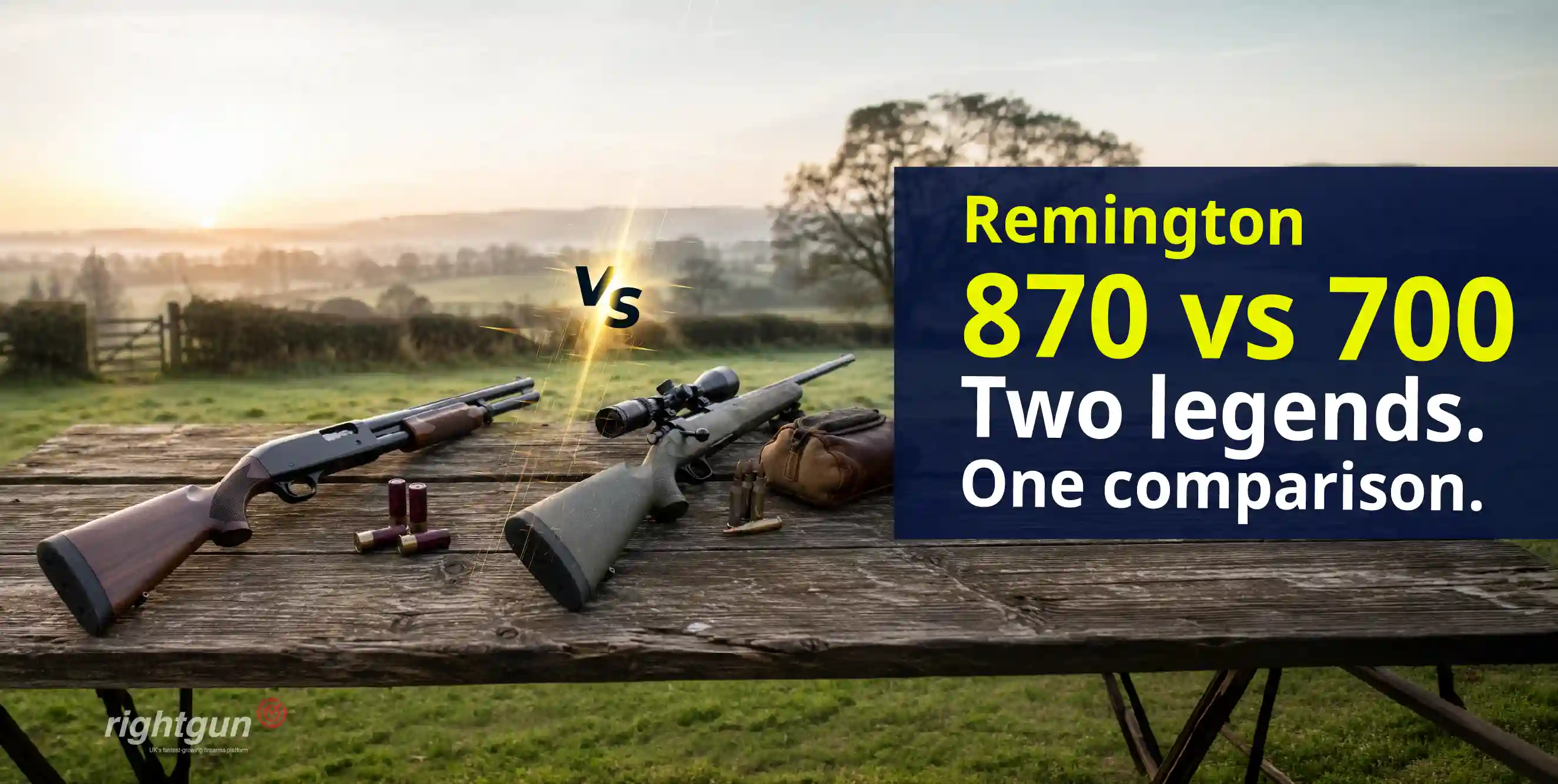
Few firearms manufacturers can claim to have produced two genuinely iconic platforms. Remington managed it twice: the 870 pump-action shotgun and the 700 bolt-action rifle. Between them, these two designs have sold in the tens of millions, served military and law enforcement agencies across the globe, and become benchmarks against which all competitors are measured. Both have a significant presence in the UK shooting scene, whether in the hands of wildfowlers, deer stalkers, pest controllers or target shooters.
Comparing them directly is not entirely straightforward because they serve fundamentally different purposes; one is a shotgun, the other a rifle. But understanding what makes each platform special, which variants to look for, what problems to watch out for, and how they fit into UK shooting life is valuable whether you are considering your first Remington purchase or adding to a collection that already includes one of them.
The Remington 870: A brief history
The Remington 870 was introduced in 1950 and became an immediate commercial success. Designed by a team led by L. Ray Critchfield, it replaced the earlier Model 31 and was built around a philosophy of strength, simplicity and reliability. The receiver is machined from a solid steel billet rather than stamped from sheet metal, which gives it a solidity that cheaper pump-actions simply cannot match. The dual-action bars, two steel bars connecting the forend to the bolt assembly, provide smooth, balanced cycling that resists the binding and twisting that can plague single-bar designs.
Over seventy years later, the fundamental design has barely changed. The action still locks up with the same confidence, the dual bars still cycle with the same smoothness, and the platform still inspires the kind of trust that makes people reach for it when reliability matters more than anything else. More than eleven million 870s have been produced, making it the best-selling pump-action shotgun in history.
In the UK, the 870 occupies a particular niche. Pump-action shotguns require a Section 1 firearms certificate rather than a shotgun certificate, which limits their appeal to shooters who already hold or are willing to apply for a Section 1. This means the UK 870 market is smaller and more specialised than in countries where pump-actions are unrestricted, but demand remains strong among wildfowlers, security professionals and those who simply appreciate the platform's unmatched dependability.
The Remington 700: A brief history
The Remington 700 arrived in 1962, evolving from the earlier Model 721 and 722 designs. Where the 870 was built for the shotgunner, the 700 was engineered for the rifleman who needed precision above all else. The cylindrical receiver, round in cross-section and machined to tight tolerances, provides an inherently strong and concentric foundation for the barrel and action. The Walker trigger, named for designer Mike Walker, offered a crisp, adjustable pull that set the standard for factory bolt-action triggers for decades.
The 700 became the basis for the United States military's M24 sniper weapon system and later the M40 used by the Marine Corps, which speaks volumes about its accuracy potential and structural integrity. In the civilian market, it established itself as the go-to platform for hunters, target shooters and long-range enthusiasts worldwide. The aftermarket support that grew up around the 700 is arguably unmatched by any other bolt-action rifle; there is quite literally nothing you cannot do to customise, modify or improve a Remington 700.
In the UK, the 700 is a popular choice for deer stalkers and target shooters. It is available in a range of chamberings suited to UK quarry, from .243 Winchester for roe deer to .308 Winchester and .30-06 Springfield for larger species. The platform's modularity and the vast aftermarket mean that a 700 can be configured for any purpose, from a lightweight hill-stalking rifle to a heavy-barrelled varmint rig or a precision target platform.
Key 870 variants to look for
The 870 range has spawned dozens of variants over its production life, and knowing which ones are desirable in the UK context will help you navigate the new and second-hand markets.
The Wingmaster is the premium sporting model, featuring a polished blued finish, quality walnut furniture and the best overall fit and finish in the range. Wingmasters command the highest prices on the used market and are particularly sought after in older, pre-1980s examples where the machining quality was at its peak. If you want an 870 for game shooting or wildfowling and you appreciate fine craftsmanship, the Wingmaster is the one to find.
The Express was introduced in the 1980s as a more affordable alternative to the Wingmaster. It uses a matte bead-blasted finish rather than polished blue, and the wood is plainer and less carefully fitted. The Express is perfectly functional and represents good value, but it is worth noting that the matte finish on early Express models has a reputation for being more susceptible to surface corrosion than the polished finish on the Wingmaster, a point we will return to shortly.
The Police and Marine Magnum variants are built for hard use in demanding environments. The Marine Magnum features a nickel-plated finish that resists corrosion in salt water, making it popular with wildfowlers who shoot on estuaries and marshes. Police models are typically fitted with extended magazine tubes and synthetic stocks, and while they lack the elegance of a Wingmaster, they are virtually indestructible.
Key 700 variants to look for
The 700 range is similarly extensive, with variants tailored to every shooting discipline.
The BDL (Black Diamond Luster) is the classic sporting model, with a high-gloss blued finish, walnut stock with impressed chequering, and a hinged floorplate. The BDL is the variant most people picture when they think of a Remington 700, and clean examples hold their value well. It is an excellent all-round hunting rifle that looks handsome in the cabinet and performs reliably in the field.
The SPS (Special Purpose Synthetic) is the utilitarian choice, featuring a synthetic stock and matte finish. It is lighter than the BDL, impervious to wet weather, and represents excellent value for shooters who want 700 accuracy without paying for walnut and polish. The SPS is probably the most practical choice for UK deer stalking where you will be carrying the rifle across rough ground in all conditions.
The Varmint and Sendero models feature heavy, bull-profile barrels designed for sustained accuracy and heat dissipation. These are the variants favoured by target shooters and long-range enthusiasts. The extra barrel weight dampens vibration and provides a steadier hold from the bench, but it makes them heavier to carry in the field. If your shooting is predominantly static rather than mobile, these heavier-barrelled variants deliver measurably tighter groups.
The 700P is the law enforcement variant and is essentially the civilian-accessible version of the M24 platform. It typically comes in .308 Winchester with a heavy barrel and synthetic HS Precision stock, and it is one of the most accurate factory rifles you can buy at its price point.
Common issues: 870
The most frequently discussed problem with the 870, particularly the Express models, is surface corrosion. The matte finish applied to Express receivers and barrels is less durable than the polished blue on the Wingmaster, and if the rifle is not dried and oiled after exposure to rain, damp or salt air, rust can develop quickly. This is a cosmetic issue more than a functional one, the underlying steel is the same quality, but it catches out buyers who are used to stainless or cerakoted firearms that require less attentive maintenance.
The solution is straightforward: wipe the exterior with an oily cloth after every outing, store the gun in a dry environment, and consider having a Cerakote or similar coating applied if you shoot regularly in wet conditions. On the used market, surface rust on an Express is common and negotiable but not a reason to walk away, provided the bore is clean and the action functions correctly.
Other issues are rare. The 870 action is remarkably robust, and mechanical failures are uncommon even in heavily used examples. Check the action bars for smooth cycling, ensure the shell lifter operates cleanly, and verify that the safety functions correctly. Beyond that, the 870 is about as reliable as shotguns get.
Common issues: 700
The 700 has faced more significant controversy, centring on the Walker trigger mechanism. Over the years, reports emerged of 700s firing without the trigger being pulled, particularly in older models where the trigger connector could become displaced or where the mechanism was contaminated by debris or improper adjustment. Remington ultimately issued a recall and replacement programme, offering a new trigger mechanism, the X-Mark Pro, as a replacement for the original Walker design.
If you are buying a used Remington 700, check whether the trigger has been addressed under the recall. Any reputable seller should be able to confirm this, and the X-Mark Pro trigger is a perfectly good unit. Alternatively, many 700 owners replace the factory trigger entirely with an aftermarket unit from Timney, TriggerTech or Jewel, all of which offer superior pull quality and eliminate any concern about the original mechanism.
Beyond the trigger issue, the 700 is mechanically sound. Check the bolt face for signs of excessive pressure (cratering around the firing pin hole), inspect the bore for pitting or damage, and ensure the bolt locks up smoothly with no wobble or roughness. The 700 action is extremely strong, and genuine mechanical problems outside the trigger are very rare.
Aftermarket support
Both platforms enjoy extraordinary aftermarket support, though the 700 arguably leads the field among all bolt-action rifles globally. For the 700, you can buy replacement stocks from dozens of manufacturers in every material from laminate to carbon fibre, drop-in trigger units, custom barrels, recoil lugs, scope bases, bolt handles and complete chassis systems that transform the rifle into a modular precision platform. Companies like Accuracy International, McMillan, Manners and KRG all offer products built specifically around the 700 footprint.
The 870's aftermarket is similarly deep, if slightly less varied. Replacement barrels in different lengths and choke configurations are widely available, as are synthetic stocks, magazine extensions, follower upgrades and sighting systems. The 870's modular barrel system, where the barrel is held by a single magazine cap and can be swapped in seconds, makes it one of the most versatile shotguns you can own. A single receiver can serve as a wildfowling gun with a 30-inch barrel in the morning and a home-defence configuration with an 18-inch barrel in the afternoon, though obviously UK law restricts barrel length to a minimum of 24 inches for civilian shotguns.
UK availability and the second-hand market
Both rifles are available new in the UK through RFDs, though Remington's corporate history, including bankruptcy and acquisition, has occasionally disrupted supply chains. The second-hand market for both platforms is active and well-supplied. The 870 is commonly found in 12-gauge with occasional 20-gauge examples appearing, typically priced from around £300 for a well-used Express to £600 or more for a clean Wingmaster. The 700 is available in most popular UK stalking calibres, with used prices ranging from around £500 for a standard SPS to well over £1,000 for a Sendero or Police model in good condition.
When buying second-hand, the usual rules apply. Buy from a reputable source, inspect the bore carefully, check the mechanical function, and do not be afraid to ask questions about the rifle's history. Both platforms are robust enough that a well-maintained example with significant use can still have decades of life remaining. You can search for Remington shotguns and Remington rifles on Rightgun to see what is currently available.
How they fit the UK shooting
The 870's role in UK shooting is more niche than in countries where pump-actions sit on a shotgun certificate. The Section 1 requirement means you need a specific reason to acquire one, which in practice usually means wildfowling, pest control or security work. For wildfowlers who need a gun they can trust absolutely in harsh coastal conditions, the 870, particularly the Marine Magnum, is hard to beat. The pump action also allows the use of heavy non-toxic loads in three-inch magnum chambers without the cycling concerns that can affect semi-automatics.
The 700 has a broader UK audience. Deer stalkers, foxing enthusiasts, target shooters and long-range competitors all use the platform extensively. Its accuracy, modularity and the sheer depth of aftermarket support make it adaptable to almost any rifle discipline. Whether you are looking for a no-nonsense stalking rifle that you can carry up a Scottish hill or a precision rig for shooting steel at a thousand yards, there is a 700 configuration that will do the job.
Both rifles represent American engineering at its best, adapted and adopted by UK shooters who appreciate quality, reliability and the reassurance of a platform that has proven itself over millions of rounds and decades of hard use.
Read next:
